Five Things About Mozart That Sound Completely Made Up
Most composer trivia is boring. Born here, died there, wrote nine symphonies, moving on.
Mozart is not like that. Mozart's life is full of things that sound like someone lost a bet, and then you check and they turn out to be documented in his own handwriting.
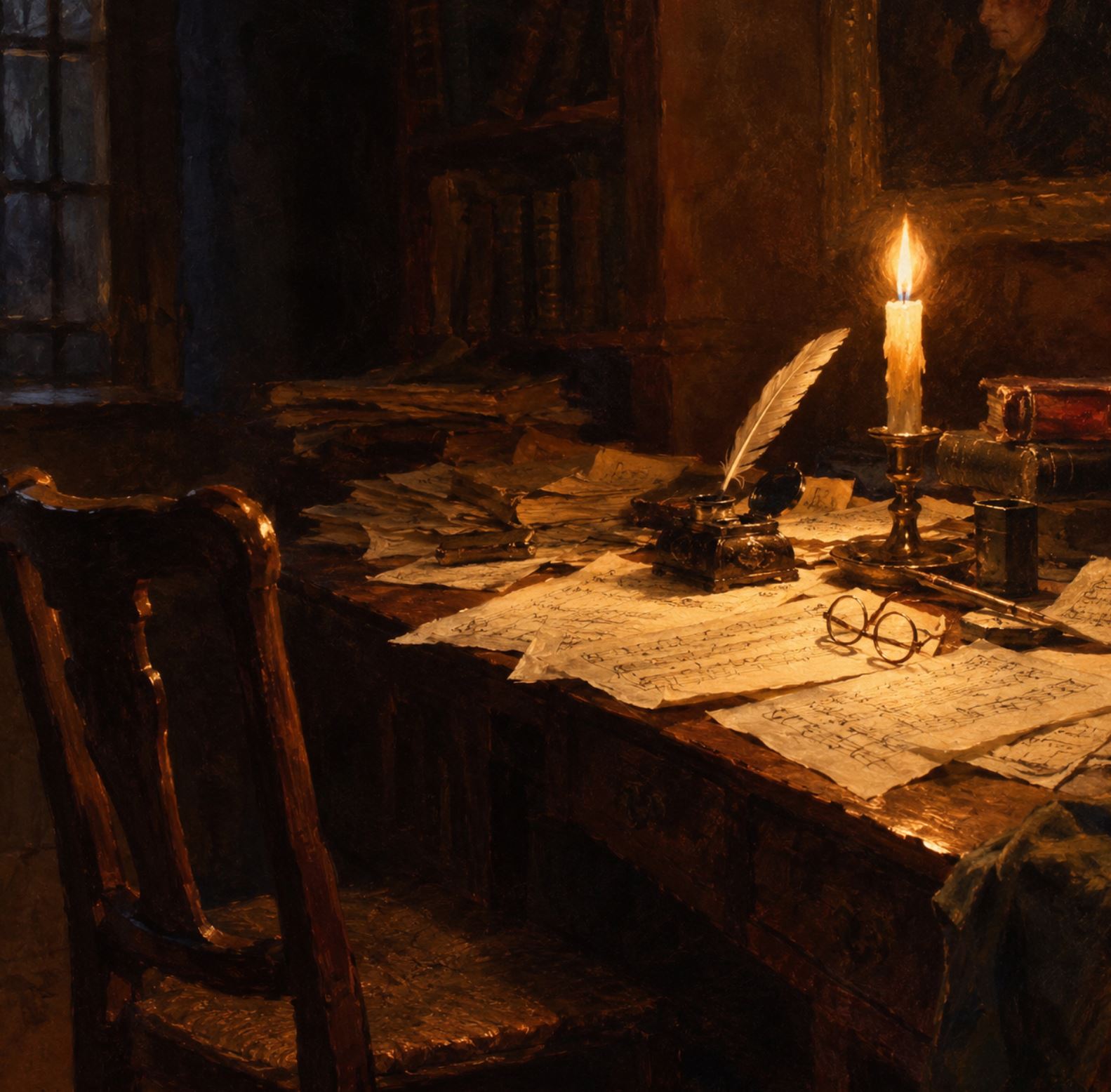
Here are five of the best.
1. He Never Called Himself Amadeus
This is the one that breaks people.
He was baptised Joannes Chrysostomus Wolfgangus Theophilus Mozart. Four names, and "Amadeus" is not among them.
The relevant one is Theophilus, which means "beloved of God", and which in his lifetime got translated into whatever language happened to be nearby: Amadeus in Latin, Gottlieb in German, Amadeo in Italian, Amadè in French. His own father wrote to a publisher announcing the birth of "Joannes Chrisostomus, Wolfgang, Gottlieb".
As an adult, the version he generally used was Wolfgang Amadè Mozart. That's what he signed.
So the most famous composer's name in history, the one on the film poster, the one on every CD you've ever seen, is a Latin translation he mostly didn't bother with. The film should probably have been called Amadè, which admittedly has less of a ring to it.
2. He Bought a Bird That Had Ripped Off His Own Concerto

May 1784. Mozart is walking past a Viennese pet shop and hears a starling whistling something suspiciously familiar.
It was, roughly, the opening of the third movement of his Piano Concerto No. 17 in G, K. 453. A piece he had finished about six weeks earlier and which had not been published.
He bought the bird on the spot for 34 kreuzer and wrote the whole thing into his expense book: the purchase, the price, and the tune the bird was singing, with the bird's slightly wrong version noted alongside his own. Underneath, he wrote "That was beautiful!"
Now, the disappointing scholarly footnote: he had probably taught it the tune himself on an earlier visit to the shop, which is a lot less magical but arguably funnier, because it means he went back specifically to buy the bird that could do his bit.
The starling lived with him for three years. When it died in 1787 he held a formal funeral in his garden, asked the mourners to come in proper mourning clothes, and read out a poem he had written for it.
His own father had died two months earlier. Mozart did not attend that funeral.
3. He Pirated the Vatican's Most Secret Piece at Fourteen
Gregorio Allegri wrote his Miserere mei, Deus in the 1630s for the Sistine Chapel, and the Vatican decided it was too good to share. It was performed during Holy Week only, inside the papal chapel only, and copying it out was forbidden.
In 1770, a fourteen-year-old Mozart turned up in Rome with his father for Easter.
He heard it once. He went back to his lodgings and wrote the whole thing out from memory, all the voice parts, including the famous ornamented passages that nobody outside the Vatican had ever seen written down. He is then said to have gone back to a second performance later that week to check his work, which is the detail that makes the story believable rather than absurd.
Pope Clement XIV, instead of excommunicating him, gave him the Order of the Golden Spur.
The honest caveat: historians have poked holes in this one. The only source is a letter from Leopold Mozart, who was a proud dad with an interest in selling his son as a miracle, and the letter has some confusing bits. There's also evidence the Miserere was already known in London, which Mozart had visited a few years earlier. So he may have had a head start.
Still an outrageous thing to do at fourteen, head start or not.
4. He Wrote a Piece of Music That Is Deliberately Awful
In June 1787 he entered a new piece in his personal catalogue: Ein musikalischer Spaß, K. 522, usually translated as A Musical Joke. It's scored for two horns and string quartet.
It is bad on purpose. Spectacularly, carefully bad. The tunes go on too long and then stop in the wrong place. The harmony lurches. There's a violin cadenza that climbs up and up and arrives somewhere insane. The horns play notes that are simply wrong. The whole thing ends on a chord where every instrument is in a different key at once, which is genuinely painful and completely intentional.
Most commentators reckon he was parodying incompetent composers. Mozart himself never said what it was for, which leaves open the delightful possibility that he just wanted to annoy people.
Go and listen to the last thirty seconds. It's worth it.
5. His Letters Are Filthy
Not sort of rude. Not a bit saucy for the period. Properly, relentlessly obsessed with bodily functions in a way that has embarrassed biographers for two centuries.
The worst offenders are the Bäsle letters, written to his cousin Maria Anna Thekla after he spent a very agreeable fortnight with her in Augsburg. They open with things like "Dearest cozz buzz!" and continue in a sort of compulsive rhyming babble where every noun gets a nonsense twin, with the filth threaded all the way through.
He wrote in the same register to his own father. One 1777 sign-off, translated faithfully, announces that he is off to the closet to shit some muck, and remains the same fool as ever. He was 21. That went in the post to his dad.
Then there's the music. In Vienna in 1782 he wrote a canon for six voices, catalogued as K. 231, titled "Leck mich im Arsch". Lick me in the arse. It's thought to have been a party piece for his friends, which tells you roughly what Mozart's parties were like.
My favourite bit of this whole saga is what happened next. After he died, Constanze sent the canons to the publisher Breitkopf & Härtel, noting that they would need adapting before anyone could print them. So the publishers quietly swapped the words out. The line meaning "lick me in the arse nice and clean" became "Nothing refreshes me more than wine", and that is what choirs sang for the next century and a half.
He also weaponised it. A canon called "Difficile lectu" exists purely to trick the baritone Johann Nepomuk Peyerl into singing fake Latin that comes out sounding like the German for lick me in the arse. Mozart then followed it with a second canon mocking Peyerl by name. He wrote two pieces of music to bully one singer.
One fair caveat before you diagnose him with anything: scholars point out that a lot of these phrases were common folk speech at the time, not Mozart inventions, and some are still current children's rhymes in southern Germany. He wasn't conjuring this stuff from nowhere. He was just extremely enthusiastic about it.
The film Amadeus took a lot of flak for portraying Mozart as a giggling vulgarian. On this specific point, the film was being polite.
The Bit That Ties It Together
Look at 1787 for a second.
His father dies in May. His pet starling dies a month or so later, and he throws it a full funeral with mourners and poetry. In June he catalogues a piece of music that is a deliberate practical joke. And in the background he is working on Don Giovanni, which is the darkest thing he ever wrote.
One scholar has suggested the starling poem is really about Mozart himself: thirty-one years old, in his prime, praised everywhere, paid almost nothing, and rather fond of playing the clown.
That's the thing about the trivia. Every fact that sounds like a punchline has something slightly heavier sitting just underneath it. The joke piece and the funeral for a bird and the poo letters are all the same person who wrote the Requiem, and they are all happening in the same few months.
Anyway. He named his bird, held it a funeral, stole from the Pope, wrote a piece designed to hurt, and never once called himself Amadeus.
Your move, Beethoven.