Maintaining Your Piano: Care Tips for Better Sound and Longevity
A piano is roughly 7,500 moving parts made mostly of wood, felt and leather, held together under something like twenty tons of combined string tension. It is a large wooden machine that lives in your living room and quietly reacts to everything the room does.
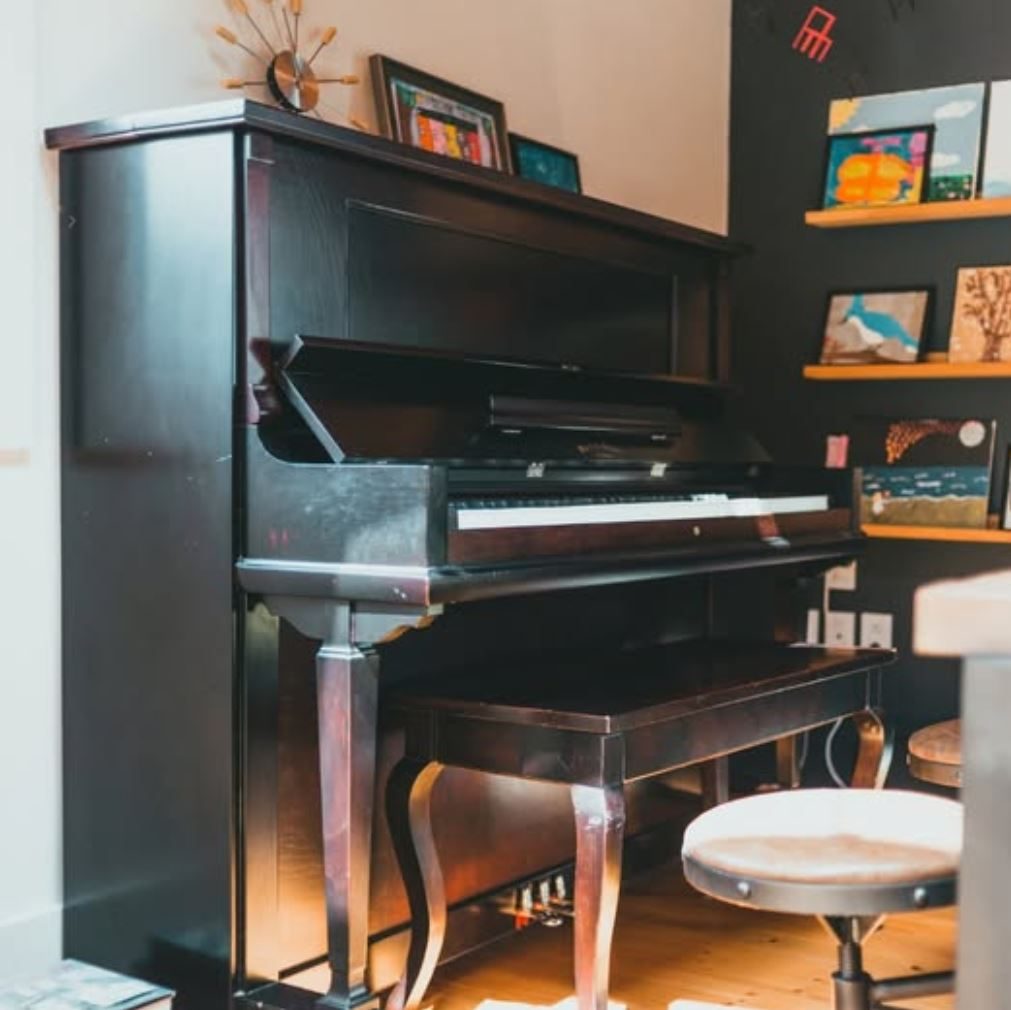
The good news is that piano maintenance is overwhelmingly preventative. Almost every expensive piano problem — cracked soundboard, loose tuning pins, sticky keys, a tone that's gone brittle — traces back to something cheap and boring that didn't get done. Humidity control. Sensible placement. Tuning on schedule.
This guide covers what you can do yourself, what you should never do yourself, and what to pay a technician for. It applies whether you've inherited a 1960s upright or just unboxed a digital.
1. Humidity Is the Whole Ball Game
Why this comes first: Everything else on this list is secondary. Wood absorbs and releases moisture from the air, and when it does, it swells and shrinks. Your soundboard is a large, thin, deliberately curved piece of wood under tension. Dry it out and it shrinks, loses its crown, and can crack. Soak it and it swells, pushes harder against the strings, and the pitch drifts sharp.
Steinway's guidance is that pianos should live in a climate of 40–60% relative humidity and 68–78°F, monitored with a hygrometer.
A note on the conflicting numbers: You'll find different figures depending where you look. Steinway's UK site suggests 45–70%. Bösendorfer officially recommends 40–60%, and Fazioli simply says never below 30% or above 70%. Technicians in practice often aim for around 42–50%.
The disagreement matters less than it seems, because they all agree on the underlying point: stability beats hitting a specific number. A piano sitting contentedly at a steady 38% is far happier than one swinging between 30% and 65% every season.
What to actually do:
- Buy a digital hygrometer. They're under £15 and they end the guesswork
- Put it in the same room, not on top of the piano
- Watch it for a month before buying any equipment
- In dry winters, run a room humidifier — not one aimed at the piano
- In humid summers, a dehumidifier or air conditioning does the job
- Consider a Dampp-Chaser Piano Life Saver system if the room simply won't behave
The warning sign to watch for: If your piano goes noticeably sharp in summer and flat in winter, that's humidity swing, and it's doing slow damage alongside the tuning drift.
2. Where You Put It Matters More Than What You Paid For It
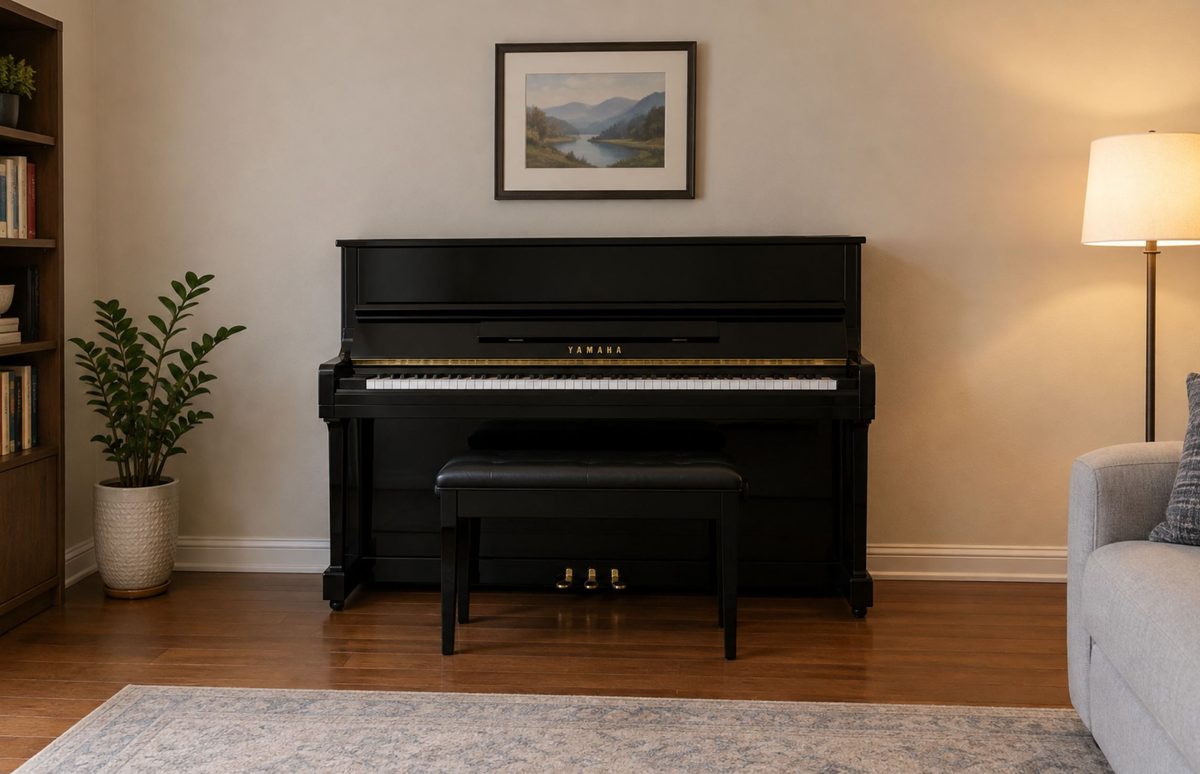
The single decision with the longest consequences: Placement is free, permanent, and almost always gets decided by which wall looks best. That's the wrong criterion.
Steinway's guidance is unambiguous — keep the piano out of the path of sunlight and away from direct air from heating or cooling vents. Their care documentation also recommends positioning it against an inside wall, away from windows, exterior doors and radiators.
The placement checklist:
- Interior wall, not an exterior one — exterior walls swing in temperature
- No direct sunlight on the case, which fades and can crack the finish
- Not next to a radiator, fireplace, or under an air vent
- Not in a conservatory, garage, or unheated room, ever
- Not against a wall shared with a bathroom or kitchen
- Avoid rooms with underfloor heating, which some makers advise against outright
Uprights have a specific vulnerability: They tend to get pushed flat against exterior walls, which puts the soundboard nearest the coldest, most variable surface in the house. If you must use an exterior wall, leave a few inches of air gap behind the instrument.
3. Tuning: How Often, and What Skipping It Actually Costs
The standard schedule: Steinway recommends tuning at least twice a year once the instrument has settled, with three or four times annually for pianos in professional use. New pianos need more frequent tuning through the first year while the strings stretch and the materials adapt to the tension. Standard concert pitch is A440.
Why "but I don't play much" is the wrong reasoning: Pianos don't drift out of tune because you play them. They drift because of humidity and temperature. An unplayed piano in a variable room goes out of tune at almost exactly the same rate as one played daily.
The compounding cost of skipping:
- Pitch drops slowly and evenly, so you stop noticing
- Bring it back after five years and it needs a pitch raise, not a tuning
- A pitch raise is often two tunings in one visit, and it may not hold
- Big tension changes stress the pinblock and bridges
- The bill for catching up is always larger than the bill for keeping up
Practical scheduling tip: Book tuning for the same two points each year — typically once after the heating season starts and once after it ends. That's when humidity has finished its big move and the tuning will hold longest.
Never attempt this yourself. Tuning requires a lever, mutes, a trained ear or software, and an understanding of pin torque. Amateur attempts routinely break strings and damage tuning pins, and the repair costs far more than the tuning you saved.
4. Cleaning the Keys Without Wrecking Them
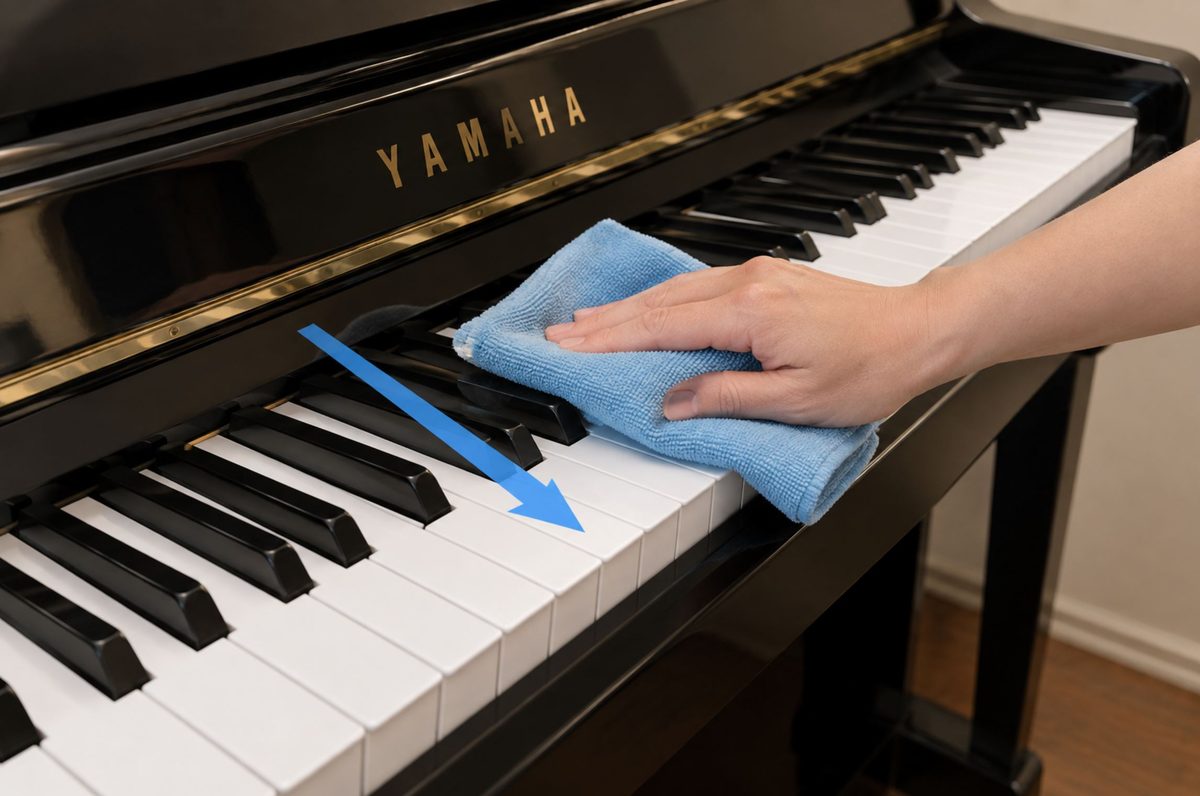
The method, which is more specific than people expect: Piano Technicians Guild guidance is to use a barely damp cloth with immediate drying, mild soap only if needed, no solvents, wiping back to front, a few keys at a time, with a separate cloth for the sharps.
Why back-to-front and not side-to-side: Wiping sideways pushes dust and moisture into the gaps between keys. Moisture that gets down there swells the wooden key sticks and gives you sticky, sluggish keys — which is a technician's job to fix, not yours.
The rules that actually matter:
- Never spray anything directly onto the keys; spray the cloth
- Wring the cloth out until it feels almost dry
- Dry each section immediately with a second cloth
- No solvents, no alcohol, no bleach, no citrus cleaners, no disinfectant wipes
- No abrasive cloths and no pressure
If your keys are ivory: Older pianos may have real ivory keytops — look for a fine grain like a fingerprint, and a hairline seam where the wide front section meets the narrow back. Ivory is porous and moisture-sensitive, so be more conservative still, and get professional advice before attempting to treat yellowing. Counterintuitively, ivory needs some light exposure to prevent yellowing, so permanently closing the fallboard on an ivory-keyed piano works against you.
Prevention beats cleaning: Wash your hands before playing. That one habit removes most of the oil and grime problem before it starts.
5. The Case Outside, and the Part You Must Not Touch Inside
Cleaning the finish: Wipe fingerprints with a soft, slightly damp cotton cloth. If you want to polish, use a water-based emulsion polish and follow the instructions. Avoid aerosol spray polishes containing silicone — silicone contaminates the finish, complicates any future refinishing, and technicians dislike it intensely.
Note that older lacquer, shellac and varnish finishes can go white when they get wet, so be more cautious with anything that isn't a modern high-gloss polyester case.
The inside is off-limits: Resist the urge to dust inside the piano, oil anything, or vacuum around the strings and action. The action is a precision assembly of thousands of parts with tolerances measured in fractions of a millimetre. Household cleaning tools knock things out of alignment, snag on dampers, and push dust deeper into the felt.
What to do instead: Ask your technician to do an interior cleaning. Every two to three years is a reasonable rhythm for most home pianos.
Other things that live inside pianos and shouldn't:
- Dust, which absorbs moisture and abrades moving parts
- Clothes moths, which eat hammer and damper felt — a real risk in stored or unused pianos
- Mice, in garage and outbuilding storage
- Coins, pencils and small toys, which fall in and jam the action
- Drinks placed on top, which is how soundboards get flooded
6. Regulation and Voicing: The Two Services Nobody Mentions
These are not tuning, and tuning won't fix what they fix.
Regulation is the mechanical adjustment of the action — the thousands of moving parts that connect key to hammer. Over years, felt compresses and wood settles, so the geometry drifts. Symptoms include an uneven or heavy feel, keys that don't repeat quickly, notes that need a hard press to sound quietly, and a general sense that the piano is fighting you. Steinway suggests full mechanism regulation and voicing roughly every five years, with incremental adjustments at each tuning.
Voicing shapes the tone by adjusting the density of the hammer felt. Hammers harden and compress where they strike, which is why an older piano can sound bright, harsh, or thin in the treble. A technician needles or otherwise treats the felt to restore an even tone across the range. It is skilled work and is not a DIY job under any circumstances.
How to tell which one you need:
- Sounds wrong, feels fine → voicing
- Feels wrong, sounds fine → regulation
- Individual notes are off pitch → tuning
- Sounds thin and lifeless everywhere → possibly voicing, possibly humidity damage
- Keys stick or don't return → regulation or moisture, and worth calling promptly
Finding a technician: Look for a Registered Piano Technician through the Piano Technicians Guild at ptg.org, or the equivalent body where you live. Ask about interior cleaning and regulation, not just tuning — many technicians will do a broader assessment if you ask.
7. If You're Learning on a Digital Piano
Most of the above doesn't apply, and that's a genuine advantage. Digitals don't need tuning, don't care about humidity in the same way, and have no soundboard to crack. If you live somewhere with wild seasonal swings, or you're renting, that's a real argument for going digital rather than a compromise.
They still need looking after:
- Dust the keys with a barely damp cloth, back to front, same as acoustic
- Manufacturers specifically warn against alcohol and chlorine-based cleaners, which cause discolouration and cracking in keytops
- Don't leave it in direct sunlight; plastic and screens both suffer
- Use the correct power adapter and don't yank the cable from the socket
- If it has weighted hammer action, the mechanism is mechanical and can still wear
- Keep drinks away from it with exactly the same discipline
The one thing digitals need that acoustics don't: Firmware and software updates on connected models, and a working backup of any recordings or settings you care about.
Common Questions About Piano Maintenance
How much should tuning cost, and how long does it take? Prices vary substantially by region, but expect roughly an hour to ninety minutes for a routine tuning. A pitch raise on a badly neglected piano takes longer and costs more, because it's effectively multiple tunings.
My piano hasn't been tuned in twenty years. Is it a lost cause? Almost certainly not, but be realistic. Have a technician assess it before spending anything. The questions that matter are whether the pinblock still holds the pins, whether the soundboard is cracked, and whether the bridges are sound. A free hand-me-down upright with a failed pinblock can cost more to make playable than a decent used piano.
Should I keep the fallboard closed? For plastic keys, yes — it keeps dust off. For real ivory, leave it open at least some of the time, since ivory yellows in permanent darkness.
Does playing a piano keep it healthy? To a degree. Regular playing keeps the action moving and moderately discourages moths and dust settling. But an unplayed piano in a stable, humidity-controlled room will outlast a heavily played one in a damp garage by decades.
Can I move it myself? Uprights weigh 150–350kg and grands considerably more, with the weight distributed unevenly and the legs not designed to be pushed sideways. Get piano movers. This is not the place to save money.
Final Thoughts: A Boring Routine Beats an Expensive Rescue
Piano maintenance is unglamorous and it works. The full annual commitment for most home pianos looks like this: two tuning visits, a hygrometer you glance at now and then, a humidifier running in winter, a cloth over the keys once a month, and a technician's interior clean every couple of years.
That's it. Do that, and there's no particular reason a well-made piano shouldn't outlive you and still sound good doing it. Skip it, and you get a slow decline that's invisible year to year and shocking over a decade.
The instrument you practise on shapes how much you want to practise. A piano that's in tune, evenly regulated and pleasant to touch is a piano you'll sit down at. That, more than anything on this list, is the real return on the maintenance.