How Long Does It Take to Learn Piano? A Realistic Timeline
The honest answer to "how long does it take to learn piano" is that the question is wrong, and everyone asking it already suspects that.
Learn to do what? Play a simplified pop song badly? That's three weeks. Sight-read a Chopin nocturne at first glance? That might be fifteen years. Both of those people are "learning piano."
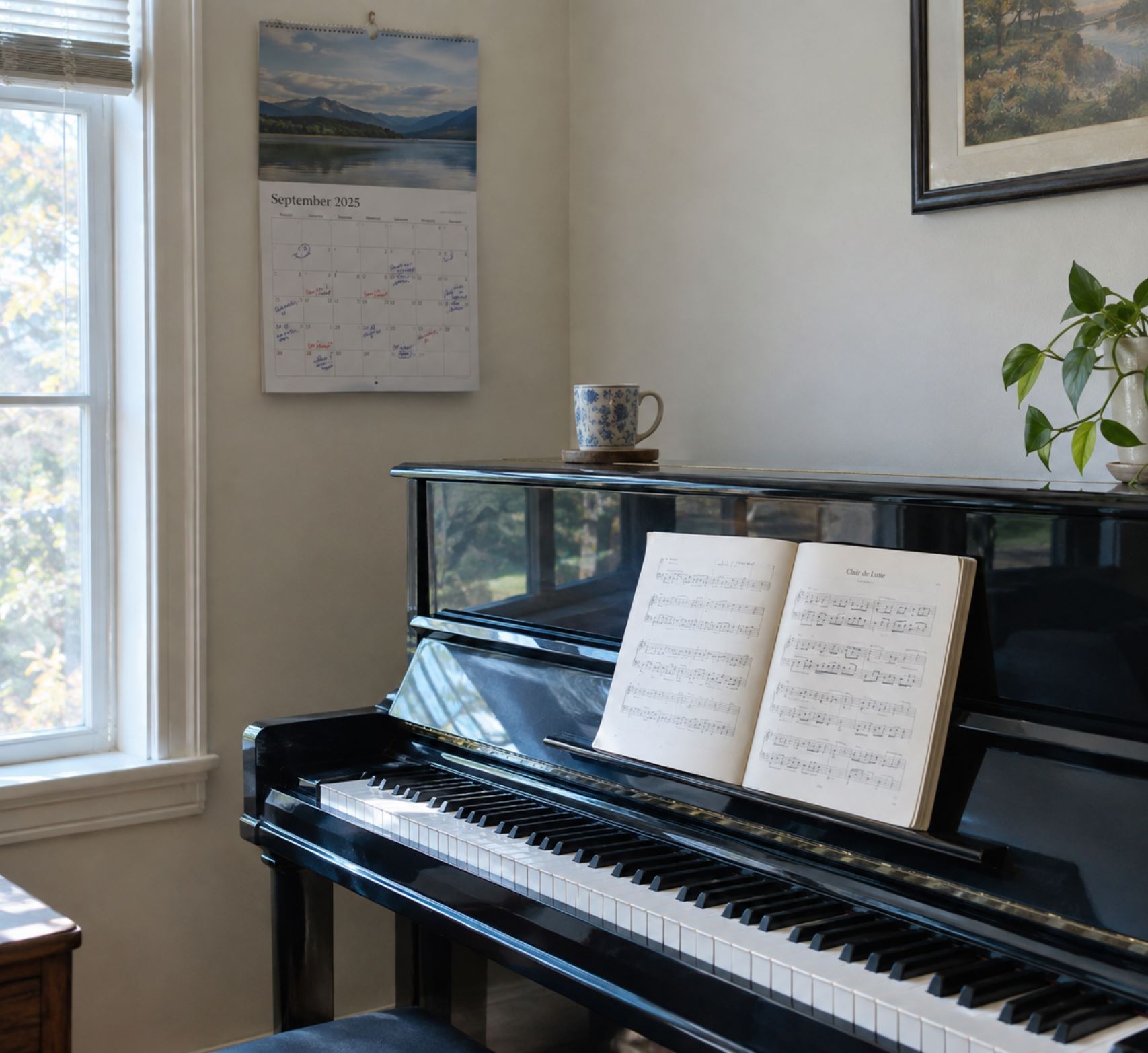
So here's the version that's actually useful: a timeline of specific, recognisable milestones, with rough ranges for how long each takes. I've assumed 20 to 30 minutes a day, most days, because that's what real adults with jobs actually manage. Double the practice and you'll compress these somewhat, though not by half, for reasons we'll get to.
Week 1: You Play a Song
Not a scale. An actual tune somebody would recognise.
Ode to Joy takes about twenty minutes to learn with your right hand. The melody moves almost entirely by step and sits inside one hand position, so there's no jumping around and nothing to memorise beyond "go up, then come back down."
This matters more than it sounds. The single biggest predictor of whether someone is still playing in a year is whether they enjoyed the first fortnight. Learning to play something real in week one is not cheating, it's the whole strategy.
What you can't do yet: use both hands, read fluently, play anything with black keys in it.
Month 1: Both Hands, Badly
Here's the first real wall, and it's a strange one: your hands will not cooperate.
The left hand wants to copy the right. Your brain will insist this is impossible and that you specifically are uncoordinated in a way other people aren't. Everyone thinks this. It passes.
Typical month one:
- Melody in the right hand, single held notes in the left
- Playing without looking down most of the time
- Recognising notes on the staff, slowly, by counting from middle C
- Somewhere between three and six simple pieces
- The first time something sounds like music rather than typing
Honest expectation: hands-together coordination arrives suddenly rather than gradually. You'll fail at it for two weeks and then one evening it just works. That's normal and it's why people quit in week three, right before the payoff.
Month 3: The First Real Milestone
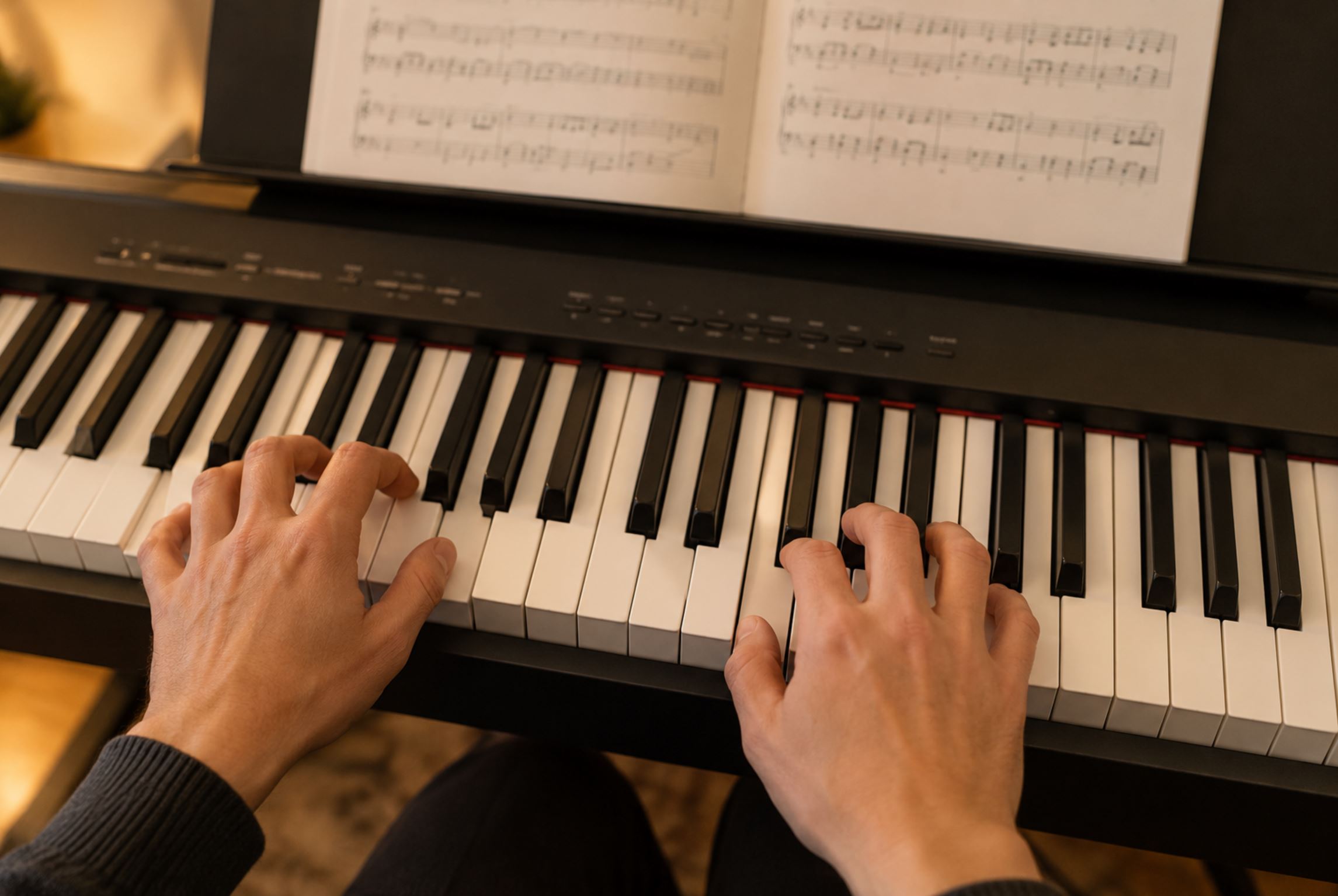
Three months is roughly when you stop being a person messing about at a piano and start being a person who plays piano.
What's usually in place:
- Comfortable in C, G and F major
- Simple chord accompaniment in the left hand under a melody
- Basic pedalling, applied inconsistently
- Reading treble clef at a slow but steady pace
- A repertoire of maybe eight to twelve short pieces
- Simplified pop arrangements are now within reach
The thing that's still hard: reading two clefs at once, at speed. Your right hand reads fine. Your left hand is still doing arithmetic.
Realistic pieces: Minuet in G, simplified film themes, early graded repertoire. Grade 1 standard, if you're in an exam system.
Month 6: The Plateau Nobody Warns You About
Somewhere between month four and month eight, progress appears to stop.
It hasn't. What's happened is that the beginner curve was steep because you were going from zero, and now each improvement is smaller relative to what you already have. You're still gaining, you just can't feel it week to week any more.
This is where most people quit. It is not a sign you've hit your ceiling. It's a sign you've left the beginner phase, which is the good news delivered in the most demoralising possible way.
What actually helps:
- Record yourself monthly. Progress you can't feel is obvious on playback across three months.
- Have a performance date. A family concert, a video to a relative, anything with a deadline.
- Switch repertoire. Boredom often masquerades as plateau.
- Reduce session length rather than skipping days. Ten minutes beats nothing by an enormous margin.
What's genuinely new by month 6: pieces with more independence between the hands, the first pieces with three or four sharps or flats, and playing something all the way through without stopping.
Year 1: Roughly Grade 2 to 3
A year of consistent daily practice usually lands somewhere around grade 2 or 3 in the ABRSM or RCM systems.
What that means in practice:
- Most beginner-and-intermediate pop arrangements are playable
- Bach's Minuet in G, Satie's first Gymnopédie, the Bach Prelude in C
- Scales in several keys, with correct fingering, at a moderate speed
- Reading well enough to learn a new simple piece from the page in a few days
- Some sense of dynamics and phrasing rather than just correct notes
What you still can't do: open unfamiliar sheet music and play it. That's a different skill and it needs its own deliberate practice, which most self-taught players never start.
The variable that dominates: not talent, not age. It's whether you practised four to six days a week or two. Two sessions a week roughly doubles every number on this page.
Year 2 to 3: The Payoff Years
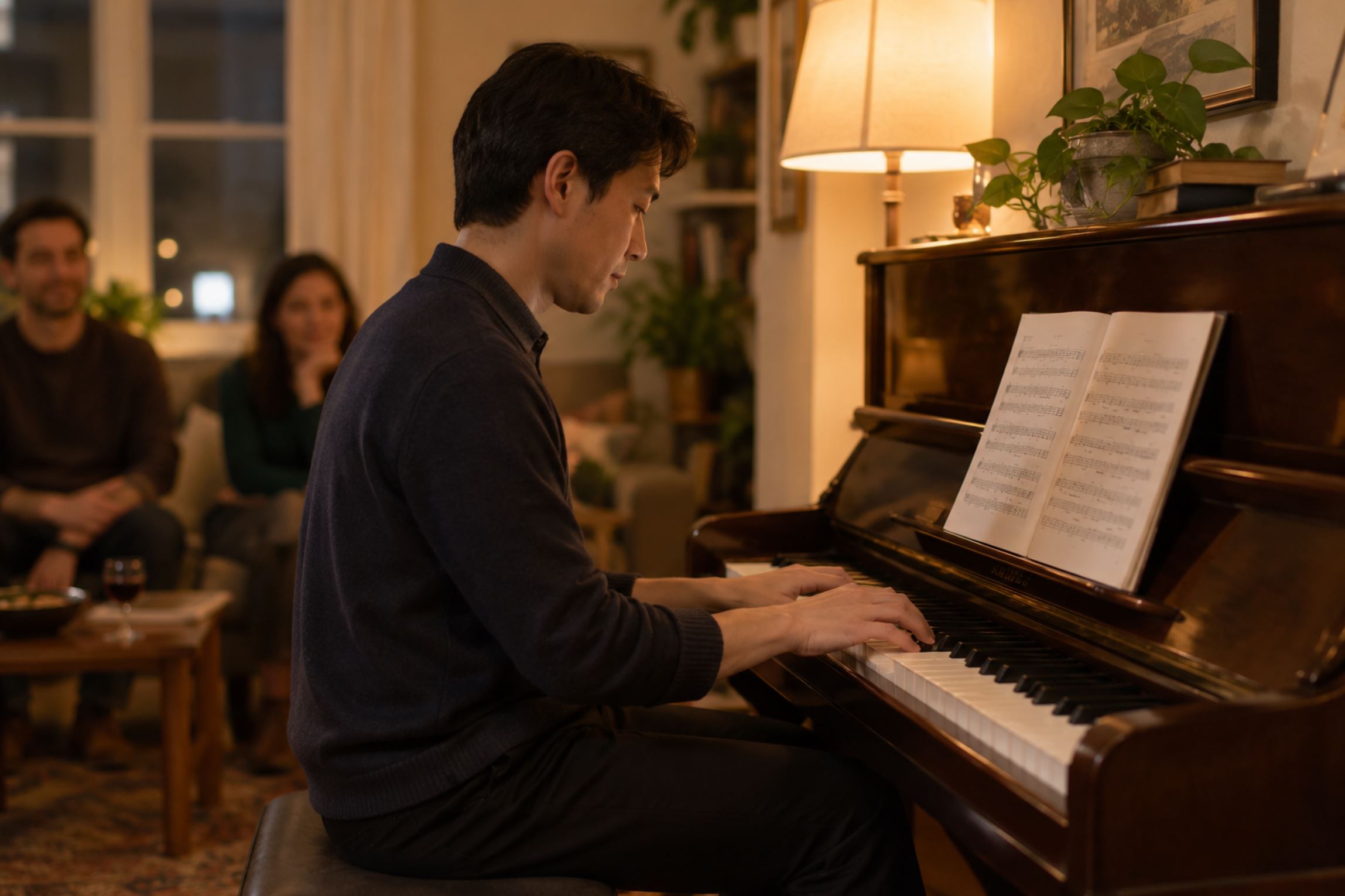
This is where the instrument starts giving back properly.
Around grade 4 to 5, typically:
- Für Elise, all sections, not just the famous bit
- Moonlight Sonata first movement
- River Flows in You and most of the popular modern repertoire
- Proper pedalling, including half-pedalling
- Playing with other people, accompanying a singer
- Learning a piece in one to three weeks rather than two months
And the big one: if you've been practising reading deliberately, you can now pick up simple unfamiliar music and play through it. That changes everything about what the instrument is for. You stop being limited to pieces someone has arranged for your level.
Year 5 and Beyond
Around grade 6 to 8 with sustained practice. At this point the ceiling is mostly a function of how much time you have, not what you're capable of.
You can learn essentially any piece you want, given enough weeks. The gap between you and a professional isn't the notes any more, it's speed of acquisition, tonal control, and the thousands of hours of repertoire they've already absorbed.
Most adult learners never get here, and that's completely fine, because almost nobody's goal was grade 8. The goal was usually "play things I love at home," and that arrived somewhere in year two.
The Factors That Actually Change the Numbers
Frequency beats duration, by a lot. Fifteen minutes on six days does more than ninety minutes on one. Motor learning consolidates between sessions, so you're buying six consolidation cycles instead of one.
A teacher roughly halves the timeline. Not because they make you practise more, but because they catch the tension, fingering and posture errors you can't see yourself, which otherwise become habits you spend months undoing. Even monthly check-ins help.
Previous musical experience carries over more than you'd think. Guitar, violin, choir, even years of listening seriously. Rhythm and reading transfer directly. A returning player who quit at 13 usually regains their old level in a fraction of the original time.
Weighted keys matter for the physical timeline. Building finger strength against springs doesn't transfer to an acoustic. Not a reason to delay starting, but it's a real factor if you plan to move to a real piano later.
Age matters much less than the internet claims. Children absorb physical technique faster. Adults absorb structure, theory and reading faster, and they chose to be there, which is the single biggest factor in whether anyone is still playing in five years.
Common Questions
Can I learn piano in 6 months? You can learn to play a decent handful of pieces in six months. You cannot become a proficient pianist. If your actual goal is "play a specific song at a wedding," six months is plenty for most songs.
Is 1 hour a day enough? More than enough, and more than most successful adult learners manage. If you can genuinely sustain an hour daily, compress the timeline above by roughly a third. Don't do an hour twice a week instead.
How long until I can play by ear? Different skill, different timeline, and largely independent. Some people pick up simple melodies by ear within months; others need years of deliberate interval training. Playing by ear and reading develop separately, and being good at one says almost nothing about the other.
Am I too old? No. Studies have taught complete beginners in their sixties, seventies and eighties well enough to measurably shift cognitive test scores within six months. The constraint on adults is calendar time, not capacity.
What's the fastest way to speed this up? In order: practise on more days per week, get occasional lessons, record yourself monthly, and learn to read music properly rather than relying on an app to show you which key to press. That last one is the difference between a two-year plateau and continuous progress.
The Honest Summary
3 weeks — you play a recognisable tune 3 months — you sound like someone who plays piano 1 year — most beginner repertoire is open to you 2 to 3 years — the pieces you originally wanted to play 5 years — you can learn almost anything, given time
Every number above assumes consistency, and consistency is the only variable you actually control. Nobody has ever failed at piano because of talent. People fail at piano because they practised hard for three weeks in January and then didn't touch it until March.
Twenty minutes, most days. That's the whole secret, and it's why nobody sells a course on it.