How to Get Your Kid to Practise Piano (Without the Daily Fight)
Almost every parent whose child plays piano arrives at the same evening.
You say it's practice time. They say five more minutes. You say you're paying for lessons. They go and sit at the piano with the posture of someone waiting at the DMV, play their scales at half attention for eleven minutes, and the two of you have effectively agreed that the piano is a chore you're enforcing and they're enduring.
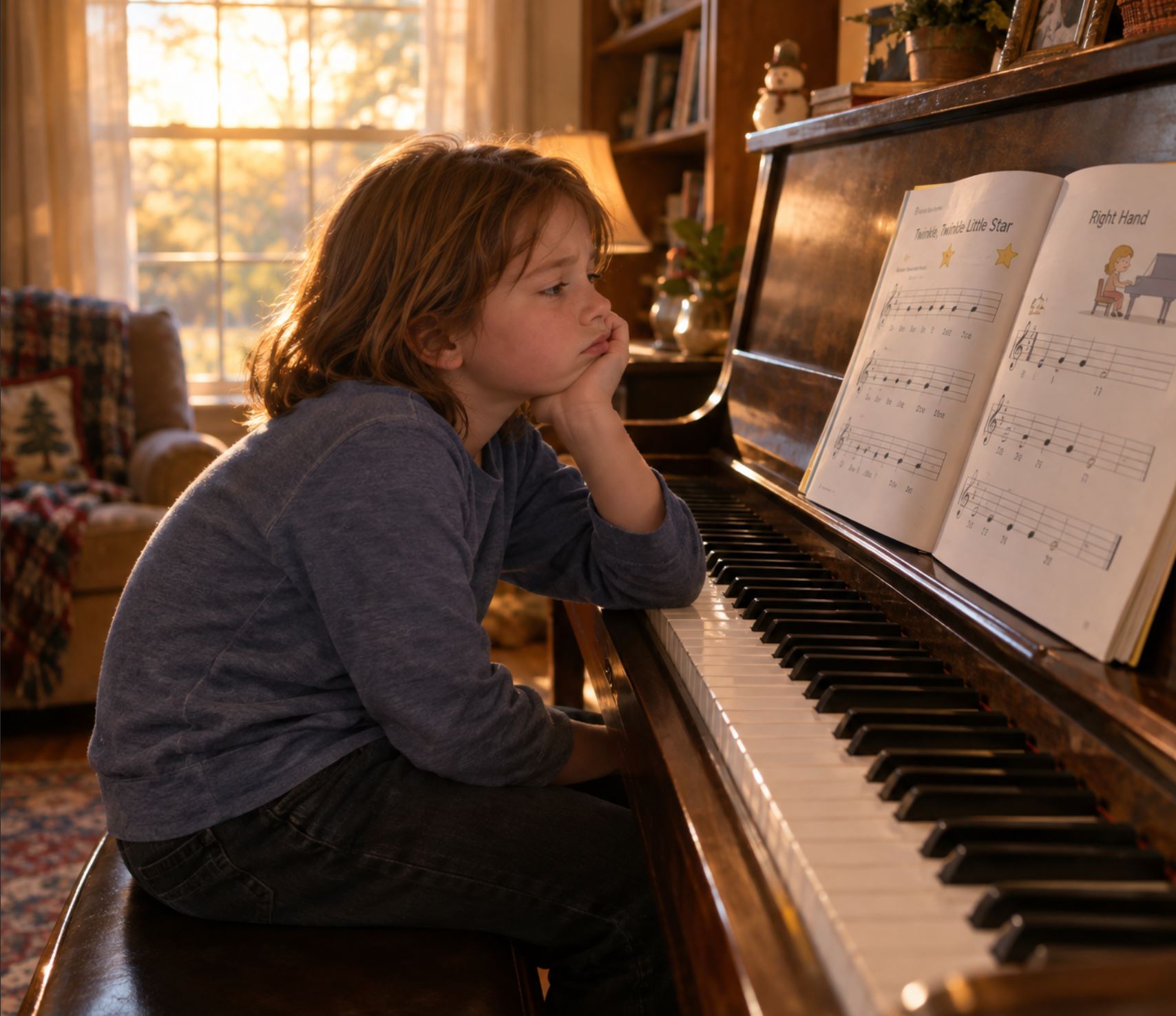
Here's the thing I'd want someone to have told me earlier: that dynamic is almost never a discipline problem. It's a framing problem. Once practice has been established as something happening to them, no reward chart fixes it, because the chart is just another piece of evidence that this needs bribing.
The good news is that the framing is changeable, and the changes are small. Below is what actually shifts it.
1. Stop Making It a Thing They're Doing Against Their Will
The single most important reframe: The phrase "have you done your practice?" tells a child exactly what category piano belongs in. It's the same sentence as "have you done your homework?" and "have you tidied your room?" You've filed it under obligations, and children are extremely good at detecting which category something is in.
Compare it to how you'd talk about something they chose. You don't ask whether they've done their Lego. You ask what they're building.
Small changes that carry a lot:
- "Want to show me what you're working on?" instead of "have you practised?"
- "Is that the one with the tricky bit in the middle?" instead of "how long have you been at it?"
- Sitting down nearby with a book rather than supervising from the doorway
- Letting them choose when within a window rather than dictating the minute
- Never using piano as a punishment or its removal as a threat — that one does years of damage in a single sentence
The uncomfortable bit: If you're using screen time as the currency — practise first, then tablet — you've priced piano as the cost of something better. It works for a while and it teaches exactly the wrong lesson. If you need a sequence, make it "we do music, then dinner," so it sits between two neutral things rather than in front of a reward.
2. Let Them Learn Something They Actually Want to Play
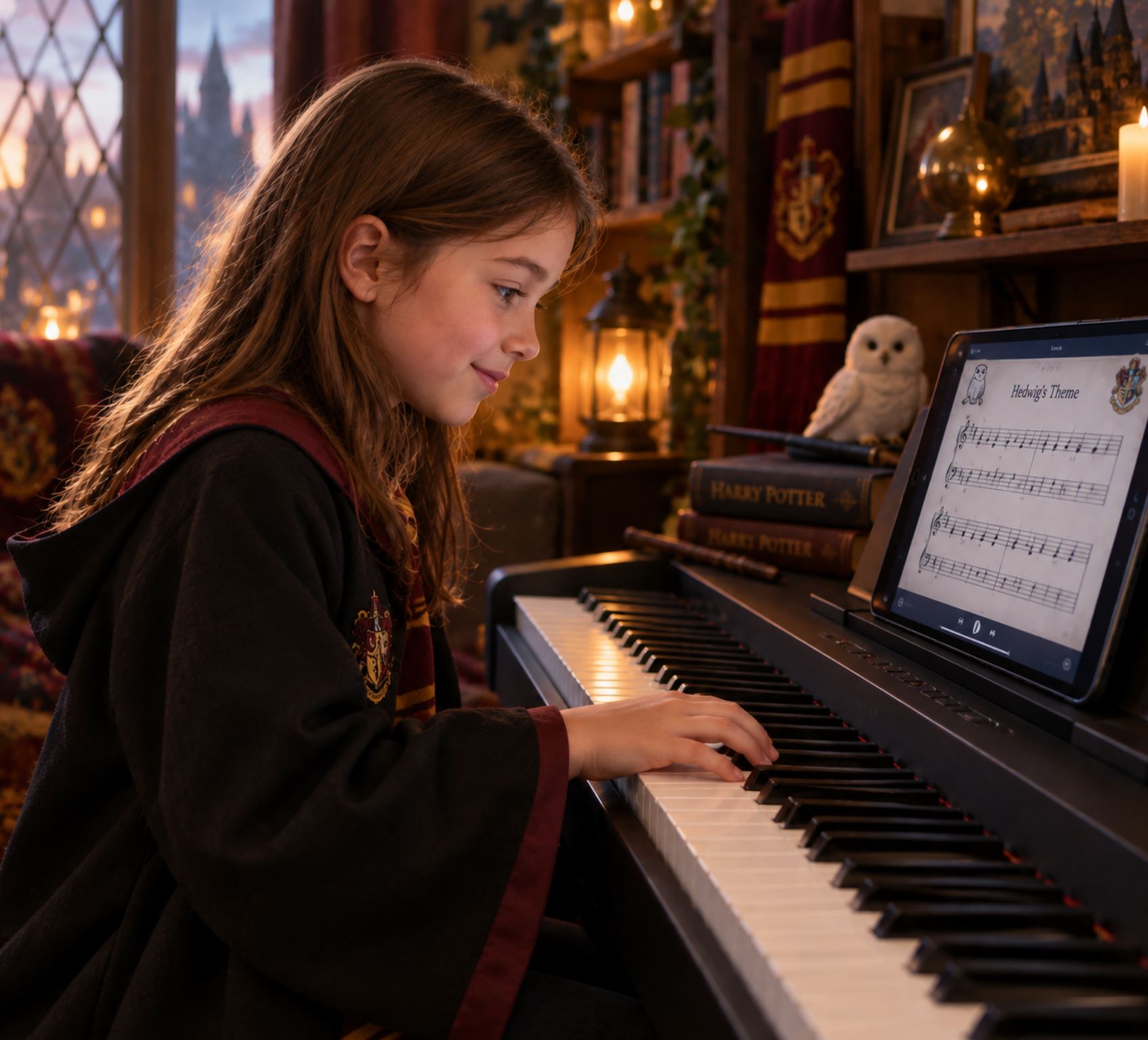
This is the lever nobody pulls hard enough.
Method books exist for good reasons. They build reading, they sequence technique properly, they don't skip anything. They are also, from a seven-year-old's perspective, a book of songs nobody has ever heard.
A child who can play eight bars of the Harry Potter theme has something they can play at people. A child who has completed page 23 of Book 2 has nothing to show anyone. Those two children practise at completely different rates, and it has nothing to do with discipline.
The kind of thing that works:
- Hedwig's Theme, because the first phrase is genuinely playable early and instantly recognisable
- A theme from a game they're playing — Minecraft, Zelda, whatever's current
- The first eight bars of something from a film they love
- Anything a friend or sibling would recognise within two seconds
How to introduce it without undermining the lessons: Talk to their teacher. Most are delighted — a motivated student is easier to teach than a compliant one, and any decent teacher has simplified arrangements of popular pieces ready to go. Frame it as "alongside the book, not instead of it," and you'll rarely get pushback.
The rule that keeps it honest: The fun piece isn't a reward for finishing the method book. It runs in parallel. The moment it becomes conditional, it turns into another chore with a different cover.
3. Compliment the Improvement, Not the Talent
There's a meaningful difference between two sentences:
"You're so musical" and "that bit sounded much smoother than last week."
The first is a verdict on who they are. It sounds lovely and it quietly raises the stakes — if being musical is an identity, then a hard piece becomes a threat to it, and the safest move is to stop trying hard things. The second is a comment on what they did, and it points at something they can do more of.
What specific praise sounds like:
- "The left hand was much steadier that time"
- "You didn't stop when you hit the wrong note — that's the hard part"
- "That's the first time you've played it without looking at your hands"
- "I could actually hear the quiet bit"
What to do about mistakes: Mostly nothing. Unless you're a pianist yourself, resist correcting from the sofa. You'll be wrong reasonably often, and more importantly, you'll turn yourself from audience into examiner. The teacher corrects. You listen.
One exception worth making: If they're visibly tense — hunched shoulders, stiff wrists, high elbows — that's worth mentioning, because tension is the one thing that genuinely causes harm and gets harder to unlearn the longer it runs. Say it kindly and only once per session.
4. Film Them — This Works Better Than It Has Any Right To
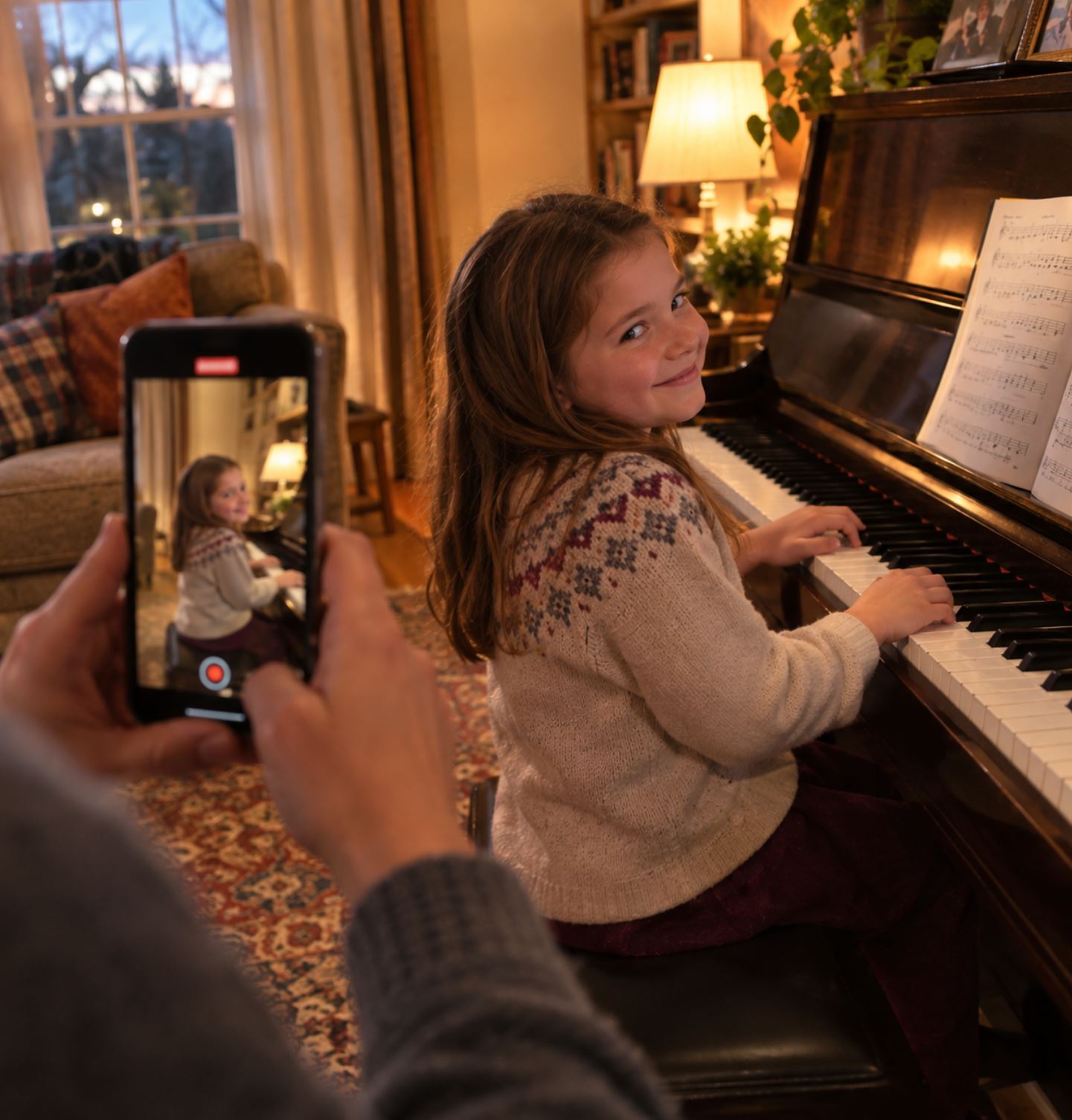
Why this one punches above its weight:
Filming does three things at once, and each of them matters.
It says you're interested. A parent who gets their phone out is a parent treating this as worth capturing, which is a completely different signal from a parent asking whether the twenty minutes are done. Children read that instantly.
It creates an audience. Playing for a camera is a low-stakes performance, and performance is the thing that makes practice make sense. Practice without any eventual audience is just repetition.
And it makes progress visible. This is the big one. Children are bad at perceiving their own improvement, because it happens too slowly to notice from inside. Play them a clip from three months ago and the reaction is genuinely startling — most kids are amazed at how much worse they used to be. It's the single most motivating thing you can show them, and it costs nothing.
How to do it so it doesn't backfire:
- Ask first, every time. A child who feels ambushed will stop playing when you enter the room.
- Film the piece they're proudest of, not the one they're struggling with
- Never film to document a failure, even affectionately
- Keep a folder and date it. Once a month is plenty.
- Send clips to a grandparent who will reply enthusiastically — the feedback loop is the point
The version that works even better: Ask them to teach you something. Hand them the phone, sit at the keys, and let them show you where to put your fingers. A child explaining a C major chord to an adult is a child who has just become the expert, and that role reversal does more for their relationship with the instrument than a month of supervised practice.
5. Give Them Something to Play Towards
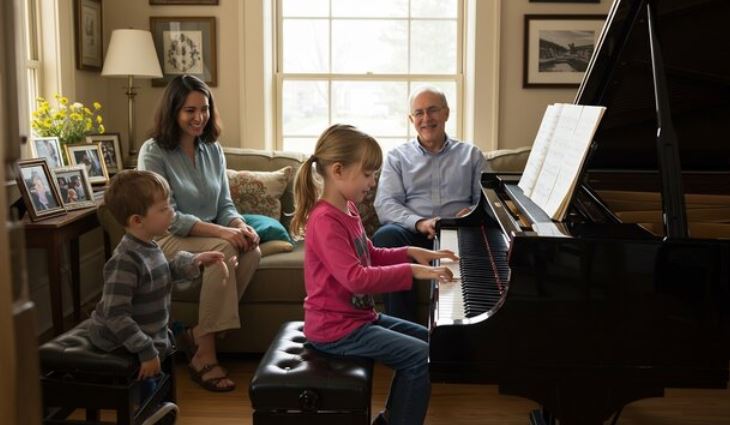
Practice without a destination is just maintenance.
Adults can sustain that. Children largely can't — and honestly, neither can most adults. What changes everything is a date on the calendar where somebody will hear it.
The family concert, which is easier than it sounds:
Pick a Sunday three weeks out. Tell them they're playing two pieces for whoever's around — grandparents, an aunt, the neighbours, a sibling with a violin. Make a programme on a piece of paper. Give it a slightly grand name. Put out biscuits.
That's it. But watch what happens to practice in the two weeks before, because now there's a reason to play the whole thing through rather than the first eight bars forty times.
Things that work as a destination:
- A monthly living-room concert with whoever's in the house
- Playing one piece over a video call to a grandparent
- Accompanying a sibling or a parent who sings, badly, with enthusiasm
- A recording sent to a cousin who plays something else
- The school talent show, if they want it and only if they want it
The rules that keep it from becoming pressure:
- Applaud at the end no matter what happened in the middle
- If they stop and restart, that's fine, and nobody comments
- They choose the pieces
- No phones out unless they've said yes
- It ends with something nice to eat
Why it matters more than practice minutes: A concert is the thing practice is for. Without one, a child is doing reps in a gym with no sport attached. With one, the reps have an obvious point, and you'll notice you stop having to ask.
6. Practical Things That Remove Friction
Small physical changes with outsized effects:
Keep the piano lid open and the book on the stand. Every additional step between walking past and playing a note is a step where they don't. An instrument that's ready costs nothing and gets touched far more often.
Put it where people are. A piano in a bedroom or a spare room upstairs is a piano that gets played less. Being able to play while a parent cooks in the next room turns it from an isolating activity into a social one.
Fix the seat height. A child on a dining chair is sitting too low with their wrists angled up, which is uncomfortable within ten minutes and quietly creates technique problems. An adjustable bench, or a cushion and a footstool so their feet aren't dangling, makes a real difference to how long they last.
Get headphones if it's a digital. Sounds counterintuitive — you'd think you want to hear them. But headphones mean they can play at 7am on a Saturday, and they mean a self-conscious child can experiment without an audience. Both increase the total hours.
Shorten the sessions. Ten focused minutes daily beats forty joyless minutes twice a week, by a lot. Consolidation happens between sessions, not during them, so frequency does more work than duration. For a young child, ten minutes is a real and sufficient number.
Common Questions
My child says they want to quit. Do I let them? Ask what specifically they want to stop — often it's the exam, or the teacher, or the book, rather than the piano. A change of repertoire or teacher solves a surprising number of quitting conversations. If it's genuinely the instrument, a negotiated break with a defined end ("let's revisit in the summer") preserves the option better than either forcing it or closing the lid for good.
How long should a young child practise? Roughly five to ten minutes daily for under-sevens, ten to twenty for primary age, more if they want it. The number that matters is days per week, not minutes per day. Six short sessions beat two long ones every time.
Should I sit with them? For younger children, yes, and it helps enormously — but as an interested companion, not a supervisor. Read a book in the same room. Ask about what they're playing when they stop. The presence is the point, not the monitoring.
They only want to play the same song over and over. Let them. Repetition of something loved builds fluency, confidence and a sense of ownership, and it's how most self-taught musicians start. The teacher will handle breadth.
Is a reward chart a bad idea? Not inherently, but be careful what it rewards. A chart for showing up daily is fine. A chart where piano earns screen time prices piano as the unpleasant thing. And charts have a shelf life — build the concert habit before the stickers stop working.
What if I don't play piano myself? An advantage, in one specific way: you can be a genuine audience rather than a critic. You can also learn alongside them, which