The 3 Best Piano Keyboards for Beginners (2026)
Disclosure: some links below are affiliate links. If you buy through them we may earn a small commission at no extra cost to you. It doesn't affect which instruments we recommend.
Most buying guides sort keyboards by price and leave you to work out which bracket you belong in. That's backwards. The question that actually determines what you should buy is this:
Do you already know you're going to stick with it?
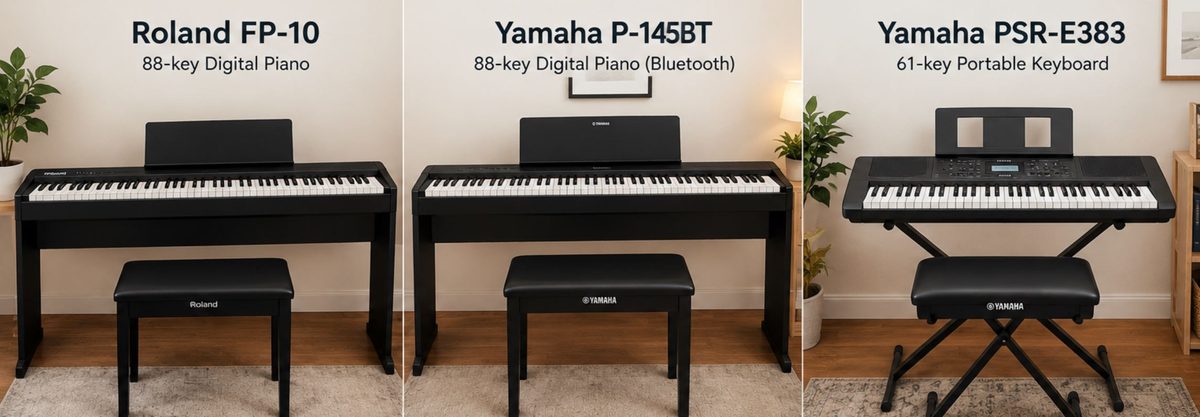
If yes, buy weighted keys now and skip the intermediate step entirely. If you're honestly unsure — testing an idea, buying for a child who asked once, returning after twenty years away — then a cheaper instrument is the correct choice, not a compromise.
Get that question right and the rest is straightforward. Three instruments cover almost everyone, and the rest of this guide explains what separates them, what the specs actually mean, and what to ignore.
1. Roland FP-10 — Best Overall
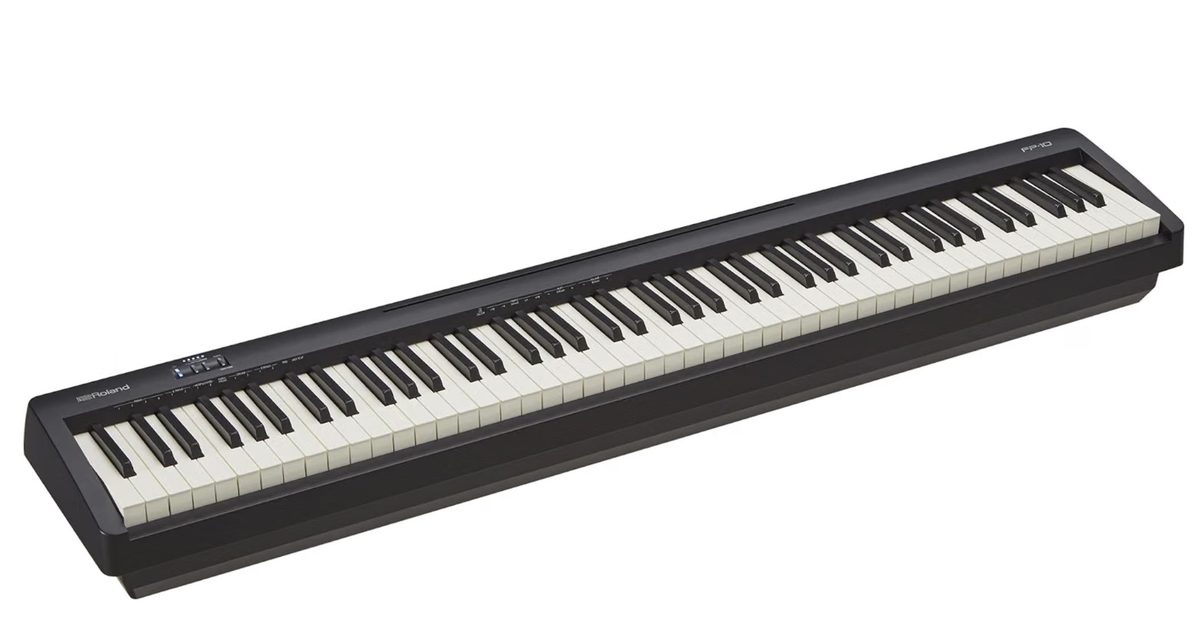
Typically $450–500 · View on Amazon
Why this is the recommendation if you only read one line: The FP-10 uses Roland's PHA-4 Standard hammer action — the same keybed Roland puts in pianos costing considerably more — with escapement, graded weighting and ivory-feel key surfaces, driven by the SuperNATURAL sound engine.
Nothing else near this price feels as close to an acoustic piano. That matters because key action is the one spec that shapes how your hands actually develop. Sounds, voices, rhythms and lesson modes are all replaceable by an app. The keybed isn't.
What it's like to live with: It's the most compact 88-key digital piano in its class, so it fits where you'd assume it wouldn't. The action is on the heavier side, which feels demanding in week one and pays off in month six — it builds finger strength that transfers directly to an acoustic. Twin Piano mode splits the keyboard into two identical ranges, which is what teachers actually use in lessons.
What you're accepting: Modest speakers. A deliberately sparse control panel that pushes you toward the phone app for anything beyond playing. Bluetooth MIDI without Bluetooth audio, so you can connect learning apps but can't stream a backing track through the piano's own speakers. And the included pedal is a basic on/off footswitch — you'll want a proper half-pedal capable pedal eventually.
Buy it if: you're taking lessons, working toward grades, or you know from experience that you finish things you start.
Full breakdown, including how it compares against the Yamaha and Casio at the same price, is in the best digital pianos under $500.
2. Yamaha P-145BT — Best All-Rounder
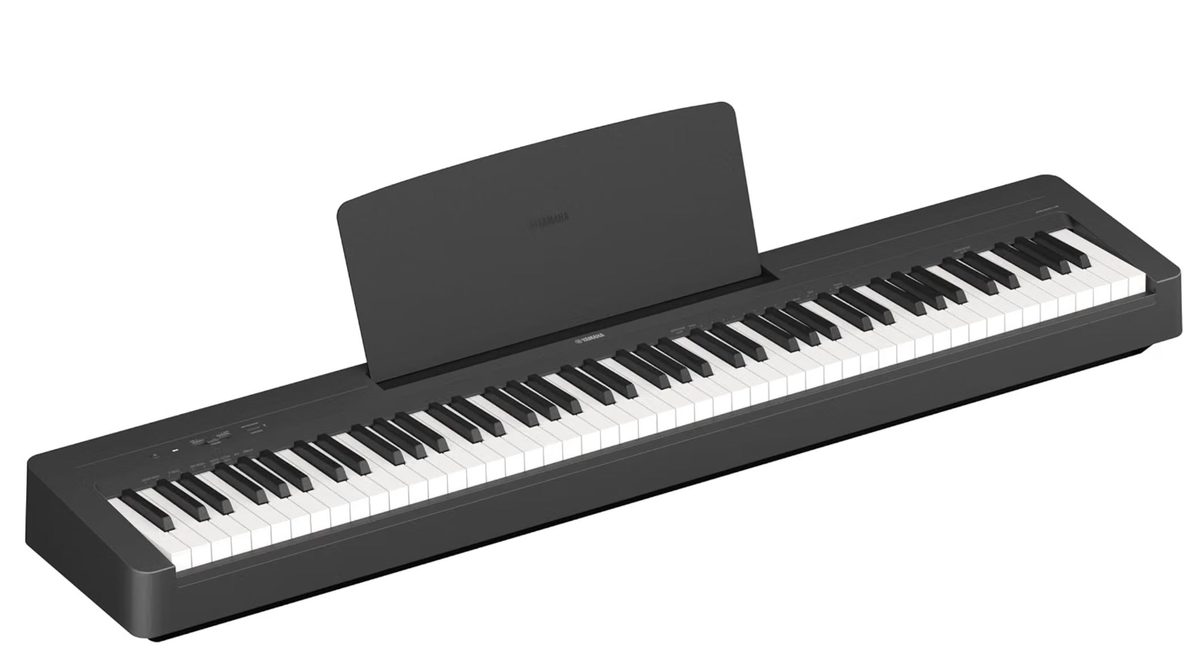
List $549.99, street $390–470 · View on Amazon
The safest purchase on this page: 88 weighted GHC keys, a grand piano voice sampled from Yamaha's CFIIIS concert grand, better speakers than the Roland, and Bluetooth audio so you can play along with music streamed from your phone. Smart Pianist handles settings, built-in lessons and sheet music display on a tablet.
Why it suits self-teachers specifically: If your practice is going to be you, a tablet and a learning app rather than a teacher, the Yamaha's software ecosystem does real work. Smart Pianist turns the sparse front panel into a proper interface. Rec'n'Share records audio and video of you playing, which sounds like a gimmick and is actually the single most motivating habit available to a beginner — hearing month one against month four is what gets people through the plateau.
The brand argument, which is not nothing: Yamaha has the best service network and the strongest resale value in the category. If the instrument develops a fault in year four, or your child quits and you want to recoup something, that matters more than any spec on the sheet.
What you're accepting: A slightly less refined action than the Roland's — GHC is a good compact action, but PHA-4 is better. And 64-note polyphony, half what most rivals offer. Polyphony is how many notes can sound simultaneously including ones still ringing under the sustain pedal; 64 is fine for essentially all beginner and intermediate playing, but dense pedalled passages can clip the oldest notes. Most players never hear it. Some do.
Watch the price. It lists at $549.99, sells around $470 at most retailers, and has dropped below $390 on Amazon during sales. Don't pay list, and don't rule it out on the list price alone.
Buy it if: you want one instrument that does everything reasonably well, you'll use the app features, and you want the brand least likely to give you trouble.
3. Yamaha PSR-E383 — Best If You're Not Sure Yet
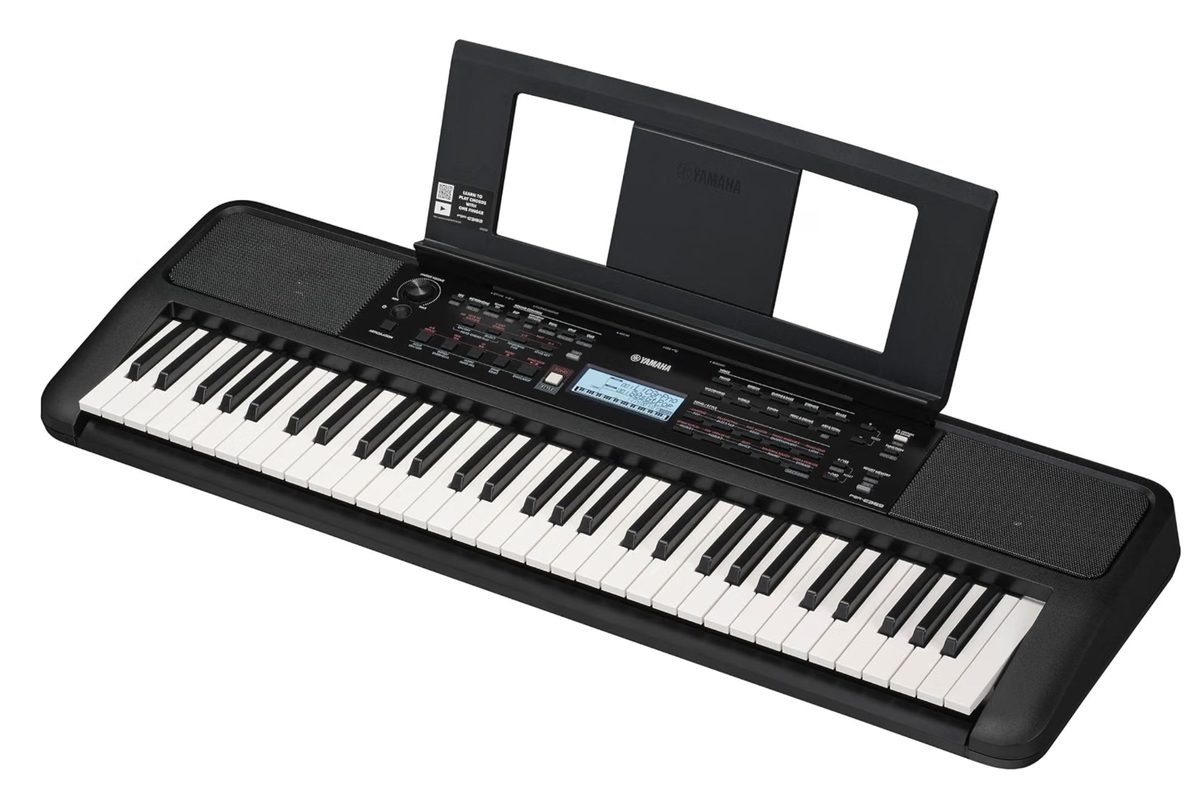
Around $200 · View on Amazon
The honest entry point: 61 touch-sensitive keys, 650 voices, 260 accompaniment styles, 125 lesson songs, and a lesson mode that teaches pieces one hand at a time. The PSR line has been the default first keyboard for two decades because it's genuinely good at the job of finding out whether you like playing piano.
Touch sensitivity is the line that matters at this price. Press harder, get a louder note. Boards cheaper than this skip it, and without it you cannot learn dynamics at all — which is most of what separates playing music from typing notes.
Features that earn their place: Duo mode splits the keyboard into two halves each with its own middle C, so a teacher or parent can sit beside you playing the same notes. Touch Tutor gives visual feedback on how hard you're striking keys. USB to Host means it works as a MIDI controller with any learning app, which extends its useful life considerably.
What you're accepting: 61 unweighted keys. You'll run out of range within a year on anything with a wide left hand, and moving to a weighted instrument later will feel like starting over physically — your fingers will have built no strength against resistance. That's a real cost, and it's worth paying only if the alternative is not starting at all.
Buy it if: you're testing the idea, buying for a child, or $200 is the number and $400 isn't.
The rest of the sub-$300 field — including 88-key semi-weighted options — is covered in the best keyboards under $300.
Also Worth Knowing About
Two instruments that aren't the overall pick but are the right answer in specific situations.
Casio CDP-S160 — around $400–450. The cheapest real hammer action from a legacy brand. Runs on batteries, weighs 23 lbs, and is slim enough to store upright behind furniture. The pick when space is the constraint rather than money. Lighter action than the Roland and no Bluetooth, but it's a genuine weighted 88 at the bottom of that bracket.
Alesis Recital — around $250–280. 88 semi-weighted keys for under $300. Semi-weighted isn't hammer action — it adds resistance but doesn't grade it or use real weighted mechanisms — so it won't build acoustic-transferable technique. What it does give you is the full range and correct keyboard geography, so you learn where notes actually live. For a lot of adult beginners that trade is worth more than 61 better keys.
Key Action: The Only Spec That Really Matters
Every other number on a spec sheet is negotiable. This one isn't, so it's worth understanding properly.
Unweighted (synth action). Keys are moved by springs. Light, fast, no resistance. Fine for organ and synth sounds, useless for building piano technique. Almost all 61-key boards under $250.
Semi-weighted. Springs plus added weight. More resistance than a synth, but the same at every pitch and without a real mechanism. A meaningful improvement in feel, not a meaningful improvement in technique-building.
Hammer action. Each key pivots an actual weighted hammer, the way an acoustic does. Your fingers work against real mass.
Graded hammer action. Hammer action where the bass keys are heavier than the treble, matching how a real piano's strings and hammers vary across the range. This is what all three legacy brands use in their sub-$500 pianos, and it's what transfers.
Escapement is the extra detail Roland includes and most rivals omit: a slight notch in the key travel as the hammer disengages from the mechanism. It matters for fast repeated notes — trills, tremolos, anything where you strike again before the key has fully returned.
Why this matters more than sound quality: You can improve a mediocre piano sound with headphones and a software instrument for £0. You cannot improve a keybed. And the physical habits you build in year one — finger strength, evenness, control over dynamics — are built against whatever resistance the keys provide. Build them against springs and you rebuild them later.
What to Ignore
Spec sheets in this category are designed to distract from the keybed. Things that sound impressive and aren't:
- Voice count. 650 voices means 648 you'll never use. You need one good piano sound. Judge that one.
- Accompaniment styles and rhythms. Fun for an evening, irrelevant to learning. Never the deciding factor.
- Built-in song libraries. You'll learn songs you chose, from apps or sheet music, not from a preset list.
- Light-up keys. They teach you to follow lights rather than read music, which is a genuinely bad habit that's hard to unlearn.
- "Complete kit" bundles. A flimsy stand, a plastic bench and a novelty microphone usually hide a worse keyboard. Buy the instrument, buy accessories separately.
- Weight and portability, unless you'll genuinely move it. Most instruments get placed once and stay there for a decade.
Things that are worth checking and rarely mentioned:
- USB-MIDI. Turns the instrument into a controller for learning apps, notation software and sight-reading trainers. Every instrument above has it. Some budget boards don't.
- Headphone output. Enables practice at any hour, which is the single largest factor in whether practice actually happens.
- Pedal jack type. Some cheap boards use a proprietary or 3.5mm jack that limits pedal options.
Set It Up Properly, Which Costs Almost Nothing
Budget $100–150 beyond the instrument, and spend it in this order.
Adjustable bench — $50–80. The first thing to buy, before a stand. A dining chair is the wrong height and tilts your wrists upward, which is where most beginner tension originates. Seated on an adjustable bench, your forearms should be roughly level with the keys and your elbows at about key height.
Stand — $40–100. An X-stand works. The manufacturer's dedicated stand looks better and is more stable. What matters is that it gets the keys to the right height with the bench you own.
Sustain pedal — $30–50. The footswitches included with most instruments are on/off only. A proper piano-style pedal with half-pedal support (Roland DP-10, M-Audio SP-2) makes a real difference from about month three onward.
Headphones. Any decent closed-back pair you already own.
Get the height right on day one. Bad seating quietly creates most of the hand position problems beginners develop, and those take far longer to unlearn than they take to avoid.