How to Actually Buy an Acoustic Piano
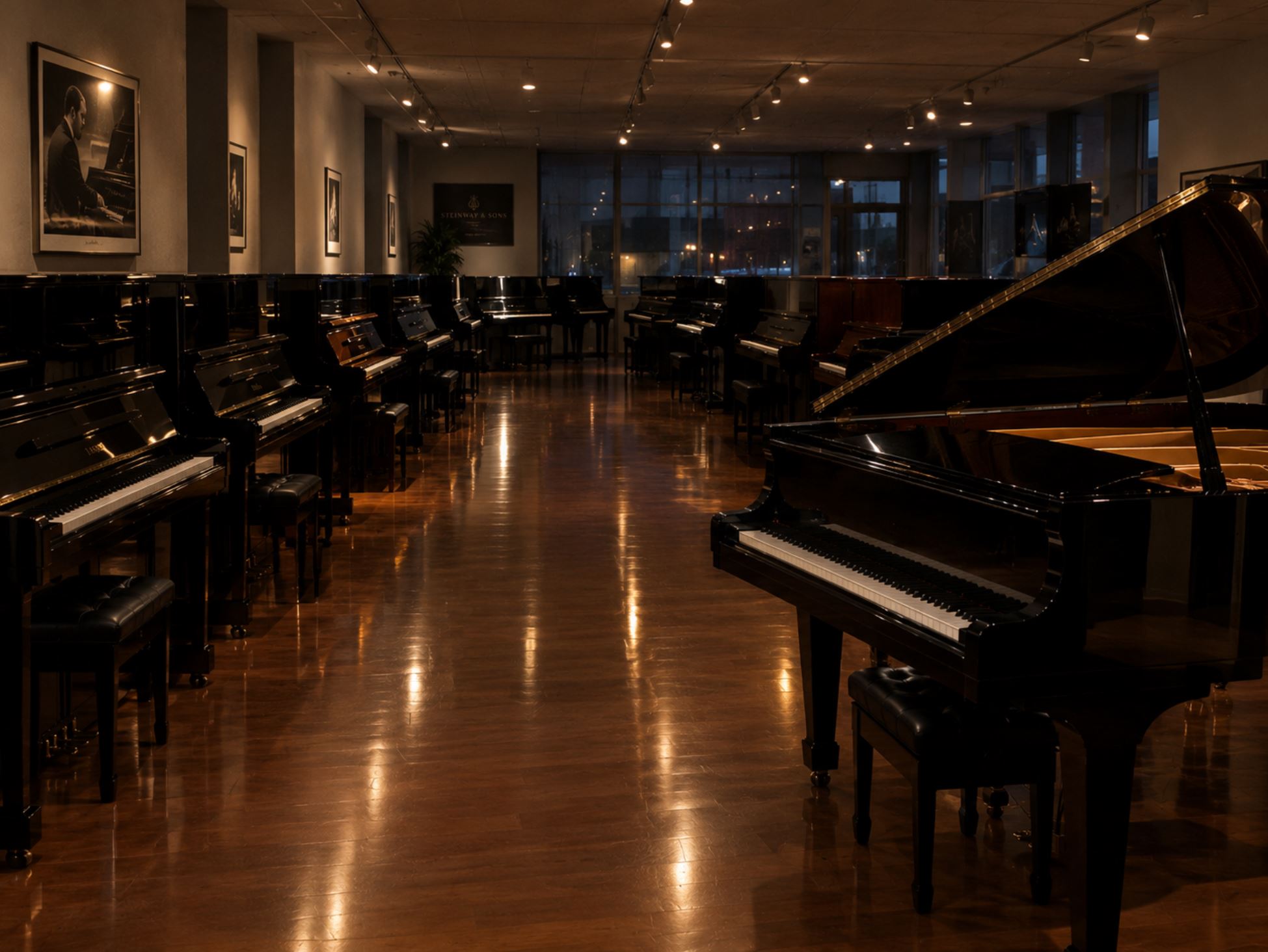
Buying an acoustic piano is unlike buying almost anything else, and the ways it's unlike are exactly the ways that catch people out.
There are no prices on the manufacturers' websites. The instrument isn't finished when it arrives. The thing you buy isn't quite the thing you played, because two pianos of the same model genuinely differ. And the cheapest piano you'll be offered — free, from a neighbour — is frequently the most expensive one you could choose.
This is the guide I'd want before starting. Real numbers, four worked budgets, and the specific things that go wrong.
First: Should You Buy One at All?
An honest question before the money.
A digital piano is the right answer for most beginners. No tuning, volume control, headphone jack, and modern weighted actions are genuinely good. Our guide to digital pianos under $500 covers that end, and for a lot of people it's where the story ends happily.
Buy acoustic if: you have the space permanently, you'll play for years, the sound and touch of a real instrument matters to you specifically, and you can carry the ongoing cost without resenting it.
Don't buy acoustic because you think it's the "proper" choice, or because someone is giving one away.
Why There Are No Prices Anywhere
This surprises everybody and it's the first thing to understand.
Acoustic pianos are sold through a dealer network, not direct. Manufacturers set a list price that is widely understood to be a starting point, dealers hold regional territory and stock, and the actual price is negotiated in the room. Discounts off list are normal and expected.
That means:
- You can't comparison-shop online the way you can for a digital piano
- Two dealers can quote materially different prices for the same model
- The quote usually bundles delivery, a first tuning or two, and a warranty — so a "higher" price may be better value
- Asking what's included is the single most useful question you can ask
It also means the thing you're buying includes a service relationship. A new piano is prepped and regulated by a technician before it leaves, tuned again once it's settled in your house, and serviced from then on. That's why the dealer system persists and why Amazon doesn't sell uprights.
What They Actually Cost, New
2026 figures, and the height matters more than the brand name.
- Console upright, 43–45 inches — $3,000 to $6,000. The standard home upright and the entry point into new acoustics.
- Studio upright, 45–47 inches — $5,000 to $8,000. Taller, fuller sound, what schools and teaching studios buy.
- Professional upright, 48–52 inches — $6,000 to $20,000. The Yamaha U1 at 48 inches starts around $12,000; the U3 at 52 inches runs about $15,700.
- Baby grand — $12,000 to $35,000.
- Grand — $40,000 and upward, with no particular ceiling.
Why height matters: a taller upright has longer strings and a larger soundboard, which produces a fuller and more resonant tone. That's physics rather than marketing. A 52-inch upright can outperform a small baby grand.
The Used Market Is Where Most People Should Look
Used acoustics generally run 40 to 50 percent below new, and the market is enormous.
To give a sense of the spread: a recent snapshot of 620 used upright listings showed a median asking price of $4,785, with a range from $100 to over $76,000. That spread tells you the "average price" of a used piano is a meaningless number.
Roughly, by type:
- Used spinet — $500 to $2,000
- Used console — $800 to $4,000
- Used studio — $1,500 to $7,000
The sweet spot, widely agreed on: Japanese production uprights from roughly 20 to 45 years old — Yamaha U-series, Kawai K-series, older Young Chang and Samick — typically $2,000 to $6,000. Consistent build quality, long service life, easy for any technician to work on, and parts are available. If you want one recommendation from this whole post, that's it.
Dealer versus private seller: dealers price higher and usually include delivery, tuning and a warranty. Private sellers price lower and you arrange everything. Both are legitimate. The dealer premium is often roughly what the extras would cost you anyway.
The Costs People Forget
This is the section that matters, because the sticker price is maybe 70% of year one.
Inspection before you buy — $150 to $300. An independent technician, not one the seller recommends. Almost nobody does this and it's the single highest-value money in the whole process. One inspection can save you four thousand dollars.
Moving — $150 to $650 for a local upright, around $700 for a grand. Specialist piano movers, never general furniture removalists. Stairs add cost. Long distance adds more. A hoist through a window, if that's what the room requires, adds a lot more.
Tuning — $90 to $250 per visit for an upright, $180 to $450 for a grand. Average around $150 and $250 respectively. Twice a year, forever. A new piano needs more frequent tuning through its first year while the strings stretch and settle.
The settling tuning — $100 to $200. Moving a piano puts it out of tune. Budget one tuning a few weeks after delivery, separate from the regular schedule.
Regulation reserve on a private-sale used piano — $300 to $500. Most used uprights eventually need the action adjusting. Hold the money back rather than discovering it later.
Over five years, a disciplined maintenance plan runs roughly $1,200 to $2,500 on top of everything above.
And the ones nobody lists: a bench, if one isn't included. A hygrometer and humidity control if the room swings. The cost of the space itself, which is real if you live somewhere small.
Four Worked Budgets
Year-one totals, so you can see what you're actually committing to.
1. The free piano from a neighbour
- Purchase: $0
- Inspection: $150
- Local move: $450
- Settling tuning: $200
- Likely repairs: $0 to $3,000+
Year one: $800 at best. Potentially $4,000.
Free pianos are usually free because moving and repairing them costs more than they're worth. That isn't cynicism, it's the market speaking. Some are genuinely fine instruments from someone downsizing. Most are not, and the only way to tell is the inspection.
2. Private-sale Japanese upright
- Purchase: $3,000
- Inspection: $150
- Local move: $450
- Settling tuning: $200
- Regulation reserve: $400
Year one: around $4,200.
This is the value route, and it's what I'd do.
3. Used from a dealer
- Purchase: $4,500, with delivery, first tuning and a warranty included
- Second tuning in year one: $150
Year one: around $4,650.
You pay more for the instrument and less for everything else, and someone is accountable if it goes wrong.
4. New console upright
- Purchase: $4,500 after negotiation
- Delivery: usually included
- First-year tunings: often one or two included, then $150 each
Year one: around $4,700, with a warranty and a brand-new instrument.
Notice how close three and four land. That's the real argument for buying new at the entry level — the gap narrows once you account for everything.
What the Inspection Is Actually Looking For
Worth knowing so you can ask intelligent questions, even though the technician does the work.
The pinblock. The laminated wooden block holding the tuning pins. If it's lost its grip, the piano won't hold a tuning, and replacing it is major surgery that usually exceeds the instrument's value. This is the one that kills pianos. A seller saying "it just needs a good tune" is sometimes describing a dead pinblock without knowing it.
The soundboard. Cracks are not automatically fatal — plenty of pianos play fine with them — but a crack combined with a lost crown means a flat, lifeless tone that can't be fixed cheaply.
The bridges. Cracks here affect tuning stability and tone, and repair is expensive.
How far off pitch it is. A piano sitting a semitone flat needs a pitch raise, not a tuning, and a pitch raise is effectively two or three tunings in one visit. It may also not hold. This is where "hasn't been tuned in fifteen years" becomes a real number.
The action. Sticky keys, uneven response, worn hammers. Fixable, priced by the hour, and the source of that $300 to $500 regulation reserve.
Moths. Genuinely. Clothes moths eat hammer and damper felt, and a piano that's sat unplayed in a garage is a candidate.
Things People Underestimate
Spinets are a trap. The shortest uprights, around 36 inches, use a drop action with linkages that makes them awkward and expensive to service, and the short strings mean poor tone. They're cheap for a reason. Many technicians would rather you bought almost anything else.
Resale value at the bottom is roughly zero. A cheap, unbranded old upright is not an asset. If you ever need to move house, you may find you can't give it away. Japanese production uprights hold value far better — another reason they're the sweet spot.
Where it goes is a permanent decision. Interior wall, away from radiators, direct sunlight and air vents. Not a conservatory, garage or unheated room. You will not be moving it on a whim. Our maintenance guide covers the humidity side in detail, and that's the thing that quietly destroys instruments.
Two of the same model differ. Wood is variable and voicing is handwork. Play the exact instrument you're buying, not a floor sample of the same model. On a used private sale, this is non-negotiable.
Stairs. Ask about stairs before you get a quote. A third-floor walk-up changes the move from $450 to something considerably less pleasant.
You can't test an old piano in ten minutes. Play every single key. Press every key down slowly to check it returns. Use the pedals. Listen for buzzing. Take twenty minutes minimum, and ideally take someone who plays better than you.
Questions to Ask the Seller
Private sale:
- When was it last tuned, and by whom?
- Has it ever been moved, and from where?
- Has it been in a garage, conservatory or unheated room?
- Why are you selling?
- May I bring a technician?
That last question is the important one. A seller who refuses is telling you something.
Dealer:
- What's included — delivery, tunings, warranty, bench?
- Is this the actual instrument I'll receive, or one from stock?
- What's the trade-in policy if I upgrade later?
- Who services it, and are they independent of you?
Common Questions
How much should I spend on my first acoustic piano? If you've decided acoustic is right, $2,000 to $6,000 on a Japanese production upright from the last few decades is the best value in the market. Below that you're usually buying someone else's problem.
Is a free piano ever worth taking? Sometimes. Pay for the inspection first. $150 to find out whether you're accepting a gift or a liability is the cheapest decision in this entire process.
Upright or grand? For a home, a tall upright. A 48 to 52 inch upright will generally sound better than a small baby grand for less money and far less floor space.
How often will I really need to tune it? Twice a year, plus extra in the first year after a move or if it's new. Pianos go out of tune from humidity and temperature, not from being played, so an unplayed piano drifts just as fast.
What if I'm not sure I'll stick with it? Then buy a digital. Our beginner buying guide covers that decision, and you can always buy an acoustic in three years when you know.
Should I buy new or used? At the entry level the year-one totals end up remarkably close once you add inspection, moving and tuning to a private sale. Used from a dealer or new both make sense. Private sale is the value play if you're willing to do the work.
The Short Version
- No prices online because it's a dealer system and prices are negotiated. Ask what's included.
- New console upright: $3,000–$6,000. Used Japanese upright, the sweet spot: $2,000–$6,000.
- Add $150–$300 for an independent inspection. Do not skip this.
- Add $150–$650 to move it, $90–$250 per tuning, twice a year.
- A free piano costs around $800 before you even find out what's wrong with it.
- Play every key on the actual instrument. Take twenty minutes.
And if any of that made you wince: a digital piano needs none of it, and the good ones are genuinely good now. That's not a consolation prize. It's a different, entirely valid answer.
Prices checked October 2026. Piano pricing varies widely by region and by dealer — treat these as ranges, not quotes.